The Voice in the Archive: Rod Serling, the WCFTR, and a Lost Dr. Jekyll
You already know the voice. Even if you’ve never watched an episode of The Twilight Zone, you can probably hear it — that measured, slightly clipped cadence, the way each word lands with the weight of a warning and the promise of a story that will stick in your head. “There is a fifth dimension beyond that which is known to man…” Rod Serling’s speaking voice became one of the most recognizable sounds in American television, the sonic signature of a place where the ordinary becomes, without warning, the uncanny.
But Serling was never just a narrator. He was one of the great writers of television’s early decades, and the voice you remember from those opening narrations belonged to a man who thought about stories with unusual seriousness. His writing carried a distinctive signature: a moral weight and a social conscience that used science fiction, fantasy, and horror as cover to talk about the things that actually frighten us. Prejudice, conformity, loneliness, the quiet cruelties people are capable of, with wit and twist endings.
So, when we learned recordings of that voice — and, remarkably, of that creative process — survived in an archive that we could help digitize, our ears perked up.
The home for a major piece of the Rod Serling story is the Wisconsin Center for Film and Theater Research. Founded in 1960, the Center began with a focus on theater and steadily expanded its reach into film and television, becoming one of the country’s most important repositories for the history of the moving image and the performing arts. It exists as a partnership between the University of Wisconsin–Madison and the Wisconsin Historical Society — an unusual and productive marriage of a research university and a historical institution, each bringing something the other needs.
Today, the Center is one of only three major institutions holding the Rod Serling Archives, alongside UCLA and Ithaca College. Ithaca makes sense on its face — Serling was from New York and taught at Ithaca College later in life. But how did a center in Madison, Wisconsin, come to hold a share of one of television’s most important writers?
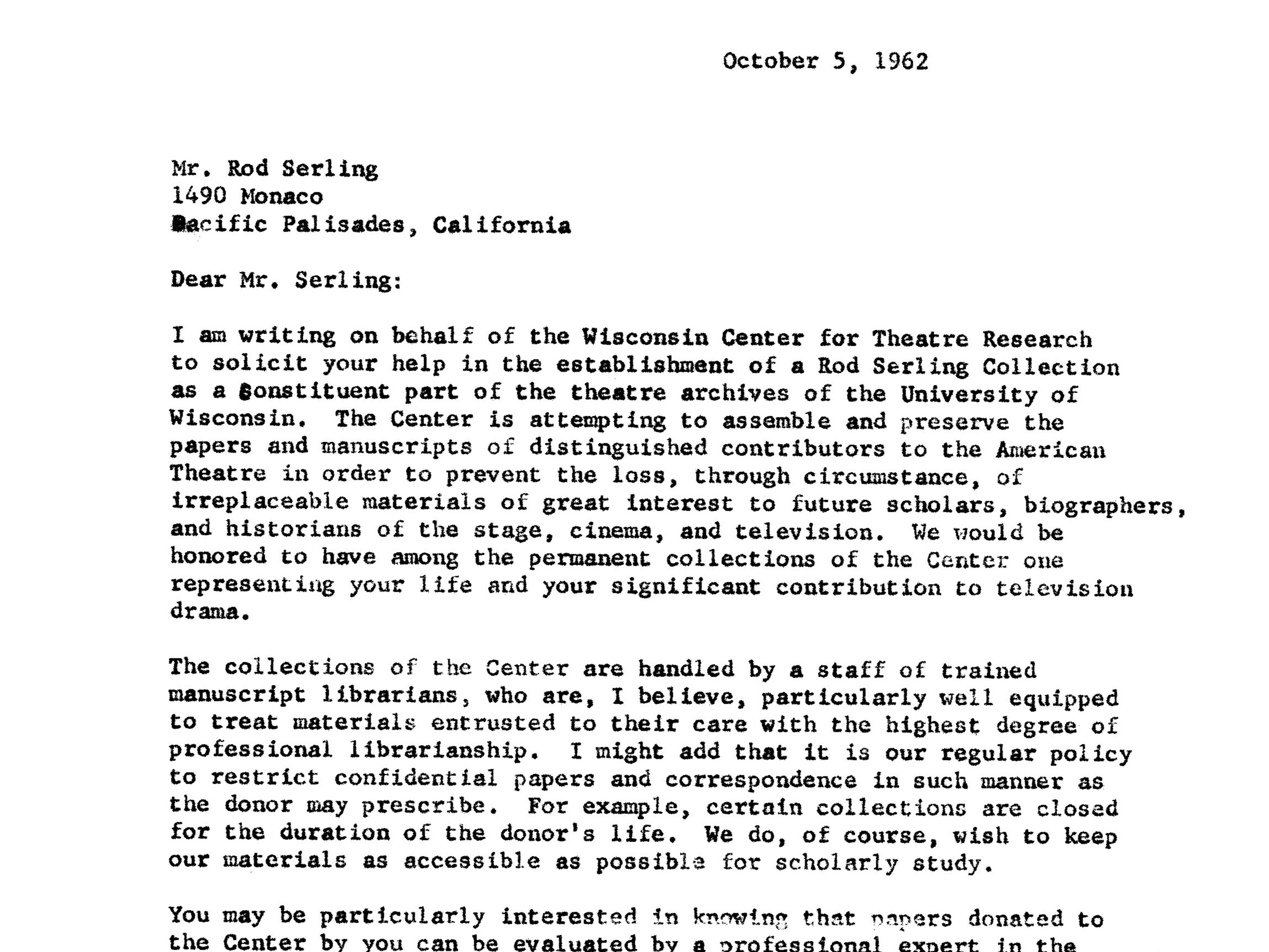
The answer is almost charmingly simple. In 1962 someone thought to write Rod Serling and ask whether he’d be willing to donate some of his materials. He said yes. That was it. From that letter grew a relationship that lasted a decade: Serling donated materials steadily from 1963 until just a few years before his death in 1975.
Here’s where the collection becomes something more than a stack of scripts and letters. In his later years, Serling worked almost entirely by voice. He dictated everything into a Dictabelt machine — scripts, letters, notes, short stories, meeting notes, the whole texture of a working writer’s life — and his secretary, Marjorie “Marge” Lansford, would transcribe it all. He’d then go back and make his corrections. It was his process, day in and day out.
What makes these recordings extraordinary is how he dictated. Serling didn’t just read dialogue. He read his scripts fully aloud — every stage direction, every character note, every camera cue. Picture that for a moment: the writer speaking not only the words his characters would say, but the very architecture of the scene, the instructions to the camera, the private notes about who these people were. The result is a set of recordings that capture two things at once — the famous speaking voice you know from the television, and the intimate, unguarded machinery of his creative process. It’s not just Rod Serling. It’s Rod Serling building.
Scene Savers had the privilege of helping to digitize and preserve this collection, carrying those fragile recordings across the gap from aging belt to secure, accessible digital files.
And then there are the some that make you catch your breath — recordings of a version of Dr. Jekyll and Mr. Hyde that Serling wrote, but which was never used. The story behind it is the kind of thing that could only happen in the churn of television production. Serling was hired to write an original screenplay for a high-profile, two-hour television adaptation of Robert Louis Stevenson’s classic gothic horror novella. The project was in strong hands: Dan Curtis, the renowned horror producer, and the script was tailor-made for the award-winning actor Jason Robards — the man you may know from All the President’s Men — who had signed on to play the dual title roles. A legendary writer, a celebrated producer, a star built for the part. Everything was in place.
Then it all came apart. Just before shooting, Robards dropped out. Combined with a union strike in the UK, the production was eventually uprooted and moved to Canada. By the time it reached the screen, it had transformed completely: it was made with Jack Palance in the title roles and became the Emmy-winning 1968 production The Strange Case of Dr. Jekyll and Mr. Hyde. None of Serling’s work made it into the final product.
Sit with that for a second. What survives from those Dictabelts is a major commission — an original screenplay by one of television’s finest writers, built around a star who never played the role, for a production that had shape-shifted beyond recognition before a single frame was shot. It is, in the most literal sense, a story that exists nowhere else. Had those recordings not been made and preserved, this entire chapter — Serling’s Jekyll, Serling’s Hyde — would simply be gone. It survives only because the belts survive, and because they were digitized before time could take them.
There’s something quietly moving about all of this. A cold letter in 1962. A writer patiently reading his stage directions into a machine. A secretary transcribing, a writer correcting. A screenplay that never made it to air, saved almost by accident because that was simply how he worked. Every step from then to now depended on someone choosing to keep the record and then, decades later, on someone choosing to rescue it from the slow decay of a plastic belt.
That’s the part of preservation that’s easy to miss. It isn’t only about safeguarding the famous and the finished. It’s about protecting the near-misses, the abandoned drafts, the working voice behind the polished product — the things that let us understand not just what got made, but how a mind actually worked. Being able to help digitize a collection like this, and to know that Rod Serling’s voice and his lost Jekyll will still be here for the next curious listener, is exactly why this work matters to us.